Open Letter: The Strategic Importance of Aerial Surveying and the 2026 Energy Crisis
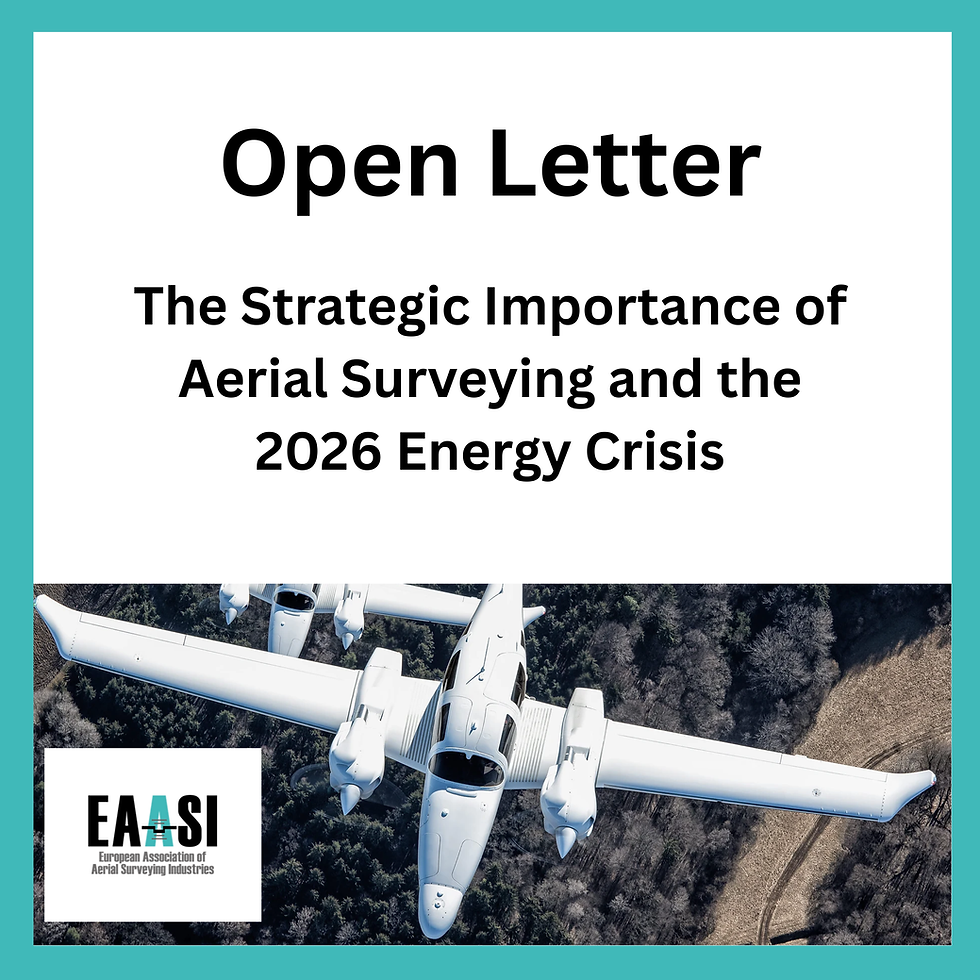
The European Association of Aerial Surveying Industries (EAASI) has published an open letter addressing the impact of rising aviation fuel prices on the sector and the potential consequences for Europe’s geospatial data supply.
As fuel costs surge and availability tightens, aerial surveying operations — essential for producing high-resolution data that supports the green and digital transitions — face increasing pressure during the peak acquisition season.
The document outlines the challenges for the industry and calls on European and national authorities to ensure continuity of these critical operations.
Read the full statement or click below to access the PDF version.
The Strategic Importance of Aerial Surveying and the
2026 Energy Crisis
Date: April 27, 2026
From: European Association of Aerial Surveying Industries (EAASI)
To: European Policymakers, Geospatial Industry Partners, and Clients
The European Association of Aerial Surveying Industries (EAASI) is closely monitoring the critical situation in the energy market. Since late February, the conflict in the Middle East has caused aviation fuel prices to increase substantially, with Northwest European benchmarks reaching record highs of $1,900 per tonne this month. While this affects the entire aviation sector, it is creating an existential challenge for the aerial surveying industry—the specialized companies responsible for the data that power Europe’s digital and green transition.
The Financial Impact on Survey Operations
The aerial surveying sector is primarily composed of Small and Medium Enterprises (SMEs) operating specialized aircraft. Unlike large commercial airlines, these companies cannot access complex "hedging" programs to lock in fuel prices months in advance. They are forced to buy fuel at "spot prices," which are currently highly elevated and volatile [1].
Aviation fuel is one of the most critical items in calculating the hourly cost of our operations. While our members’ total operational costs include many variables, the substantial and disproportionate increase in fuel prices has disrupted the financial balance of the industry. Many of our members operate under fixed-term contracts with public and private clients; these agreements are now under severe pressure as the cost of the "flying hour" has surged beyond any reasonable forecast.
A "Data Blackout" During the Peak Flying Season
On top of that, this crisis arrives at the worst possible moment for our sector. On April 16, 2026, the Executive Director of the International Energy Agency (IEA), Fatih Birol, warned that Europe has "maybe six weeks" of jet fuel reserves left. This countdown coincides exactly with the start of the most important season for aerial data acquisition in Europe.
Our members rely on clear weather windows in the spring and summer to capture high-resolution imagery and LiDAR data. If supply shortages lead to fuel rationing at regional airports, specialized survey aircraft risk being de-prioritized. A lost flying season means a "data blackout" for Europe: we cannot build digital twins, monitor forests, or manage critical infrastructure using outdated information.
Geospatial Data: A Strategic European Asset
It is vital to recognize that our industry provides the "raw material" for Europe’s strategic goals. Under the EU Open Data Directive and its 2024 Implementing Regulation, the Commission officially designated Geospatial and Earth Observation data as "High-Value Datasets" (HVD).
This designation is a legal recognition that our data provides the highest potential for socio-economic benefits and is essential for:
The European Green Deal: Providing the high-precision data needed for flood modeling, climate resilience, and the Nature Restoration Law.
Digital Sovereignty: Enabling the creation of Digital Twins for smart cities and other initiatives.
Critical Infrastructure: Monitoring energy networks and transport hubs to ensure they remain safe and efficient.
Our Call to Action
EAASI calls on European and national authorities to protect the continuity of strategic data capture by implementing the following:
Priority Access in Rationing Plans: In the event of fuel shortages, missions dedicated to the capture of "High-Value Datasets" must be recognized as essential services. National "Fuel Observatories" must ensure that regional airports remain supplied to support these strategic flights.
Incentives for Decarbonization: We urge for the immediate activation of SAF (Sustainable Aviation Fuel) incentives for small operators. Helping our industry transition away from fossil fuel dependency is the only long-term solution to this energy vulnerability.
Administrative Relief: We ask that specialized operations (Part-SPO) be protected from the collateral impact of new aviation mandates designed for large commercial fleets. Authorities should ensure that small operators are not penalized by "low-volume surcharges" or excessive administrative requirements.
Conclusion
To our clients and partners: our members are doing everything possible to maintain operations. However, the current energy shock is real and physical. We ask for your support in advocating for a sector that provides the vital information Europe needs to build a safer and more sustainable future.
Sincerely,
For and on behalf of EAASI,
Roland Stengele
President EAASI
[1] IATA FUEL Monitor https://www.iata.org/en/publications/economics/fuel-monitor/


Comments